
Fluid Architecture and Landscape Reconfiguration 流動的建築と風景の再構成
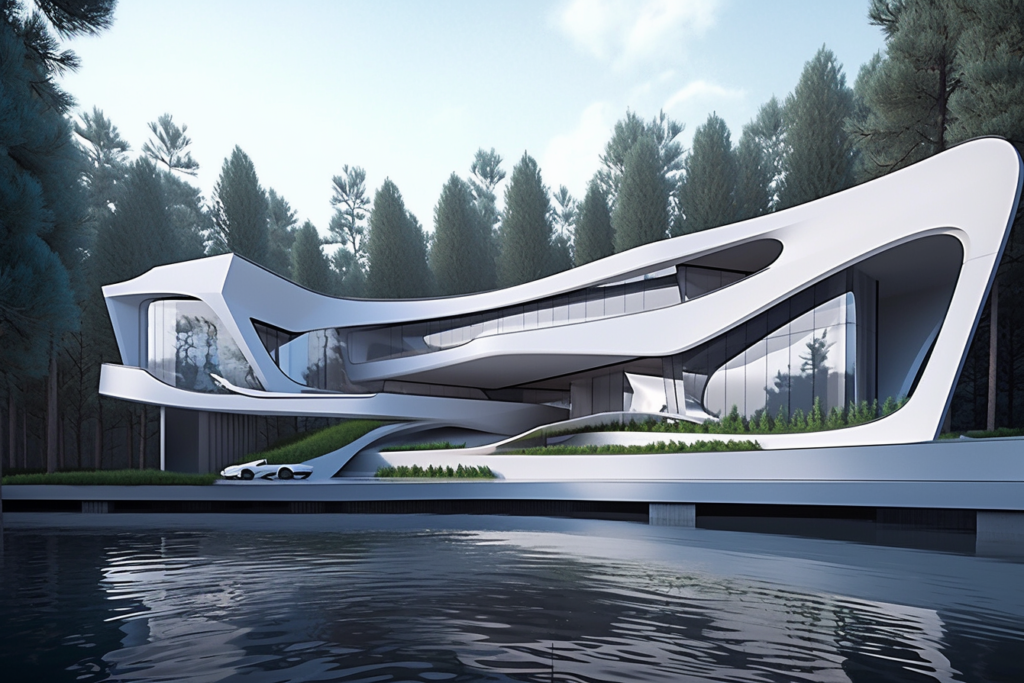
This building is planned within a natural environment surrounded by forest and water, and is characterized by an organic form that responds continuously to the surrounding landscape. The white, fluid outer shell appears to function not merely as an exterior envelope, but as a primary architectural element that integrates structure, space, and circulation throughout the building.
Formally, the architecture adopts a composition in which multiple horizontal layers gently overlap and extend, allowing the building to be perceived not as a singular mass but as an element that dissolves into the landscape. In particular, the contrast between the elevated lower volume and the low-rise portion adjacent to the water surface emphasizes a sense of liberation from gravity, while simultaneously drawing surrounding natural elements visually into the interior.
In the façade, continuous glass surfaces and irregularly shaped openings blur the boundary between interior and exterior, enhancing the fluidity of views, light, and landscape. While inheriting the modernist theme of continuity between inside and outside, this approach can be interpreted as a reconstruction of architectural expression for the post-digital era, one that dismantles the orthogonal grid.
Structurally, the extensive use of free-form surfaces suggests the adoption of shell structures, reinforced concrete, or hybrid support systems incorporating steel. Such systems enable large-span spaces and continuous interior environments that are not dependent on conventional column-and-beam frameworks.
While the architectural expression evokes associations with parametric design and organic architectural thinking developed after Zaha Hadid, it also demonstrates an environmentally oriented attitude that prioritizes harmony with the surrounding forest landscape, extending beyond mere formal experimentation.
In conclusion, this building can be positioned as an attempt to integrate natural environment, advanced form-making, and structural technology, redefining architecture as an extension of the landscape.
本建築は、森林と水辺に囲まれた自然環境の中に計画された建築であり、周囲のランドスケープと連続的に呼応する有機的な形態を特徴としている。白色を基調とした流線型の外殻は、単なる外装としてではなく、建築全体の構造・空間・動線を統合する主要な構成要素として機能しているように見受けられる。 形態的には、複数の水平レイヤーが緩やかに重なり合いながら伸長する構成が採られており、これにより建築は単一のマッスとしてではなく、風景の一部として溶け込むような印象を与える。特に、建築下部の持ち上げられたボリュームと、水面に近接した低層部との対比は、重力からの解放感を強調すると同時に、周囲の自然要素を視覚的に建築内部へ取り込む効果を生んでいる。 ファサードにおいては、連続するガラス面と不定形の開口部が内外の境界を曖昧にし、視線や光、景観の流動性を高めている。これは近代建築における「内外の連続性」というテーマを継承しつつも、直交グリッドを解体したポスト・デジタル時代の建築表現として再構築されたものと解釈できる。 構造的には、自由曲面を多用した外形から、シェル構造や鉄筋コンクリート、あるいは鋼構造と複合的な支持システムの採用が推察される。これにより、従来の柱梁構造に依存しない大開口空間や、連続的な内部空間の実現が可能となっていると考えられる。 本建築の表現は、ザハ・ハディド以降のパラメトリック・デザインや、有機的建築思想との関連性を想起させる一方で、周辺の森林景観との調和を重視している点において、単なる造形的実験に留まらない環境志向的な姿勢も読み取れる。 以上より、本建築は、自然環境・先端的造形・構造技術を統合し、建築を「風景の延長」として再定義しようとする試みとして位置づけることができる。
カテゴリー: AIartworks | Tags: architect, design, landscape, Zaha Hadid
